Numen / Applied cognition research

Numen

A mind must live in the world it understands.

Numen is Xanaheim's experimental cognitive architecture: a long-horizon test of whether grounded, pre-linguistic cognition can emerge from neuroscience-first mechanisms and embodied experience—not from language training.

Research / Operational cognitionLab / Loam T2 real-perception research
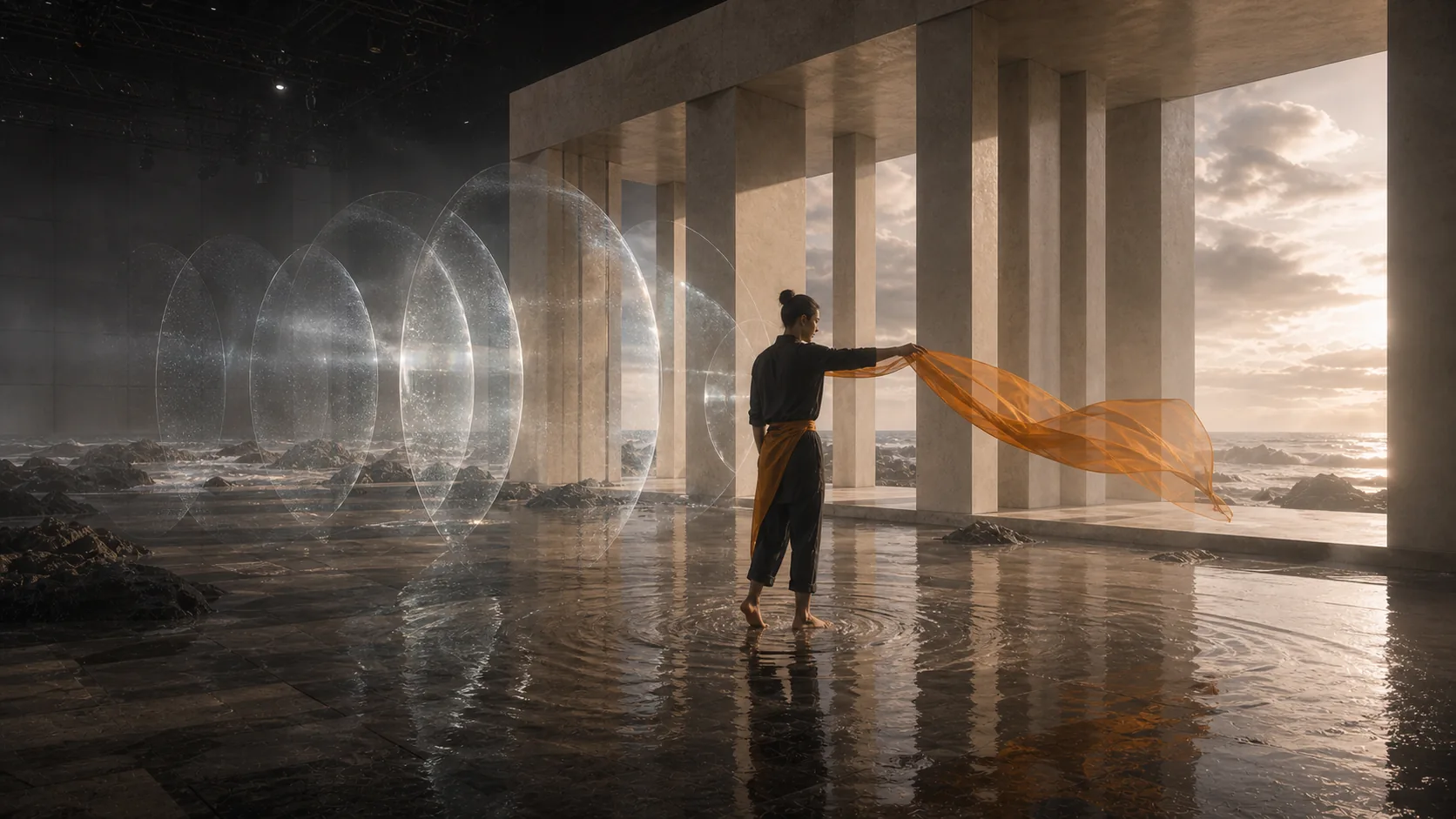
Concept study of a digital performer inside a coastal world, learning through light, sound, contact, water, and the consequences of action.Concept visualization / future cognition study

Second-order cognition

The observer is inside the loop.

Language models begin with words and infer the world from patterns in text. Numen begins with a body and a world: perceive, act, experience consequence, and carry that history forward.

The research asks an empirical question: can perception, memory, learning, prediction, affect, planning, and adaptation emerge from neuroscience-first mechanisms? Consciousness, sentience, and general-purpose AGI are outside the program.

Perceive → couple → act → remember

Meaning is acquired by living with consequences.

Before language, there must be perception, memory, learning, prediction, and adaptation. Loam tests the substrate beneath that claim: a medium changed by experience inside the closed loop.

  1. 01 / PerceiveSensory worldLight, sound, contact, state
  2. 02 / CoupleLiving mediumExperience deforms the substrate
  3. 03 / PredictPhysical back-actionNo trained readout or codebook
  4. 04 / ActEmbodied changeThe world answers back
  5. 05 / RememberRead is writeRecall changes the medium again
Concept study of one embodied Numen instance encountering wind, water, cloth, light, and remembered states in a coastal environment.Concept visualization / closed-loop study

01 / Grounding

The loop closes through the world.

Light, sound, contact, and internal state become perception. Action changes cloth, water, position, and possibility. Those consequences change the medium itself. Later recall is not a lookup: remembering deforms the memory again.

Memory
The medium is the memory
Recall
No side-effect-free read
Concept study of four independent embodied minds working as performer, camera operator, editor, and composer around one shared film world.Concept visualization / embodiment study

02 / Embodiment

The body defines the lived craft.

The same research core is designed to develop through different bodies and modalities. A performer, cinematographer, editor, and composer would be separate Numen instances—each with its own senses, actions, memory, and point of view.

Identity
One mind · one body · one history
Ensemble
Coordination through scene and message

No central synthetic director

Each Numen remains an independent cognitive locus. The ensemble works together through shared circumstances and explicit communication—not shared memory or one hidden mind behind every role.

Loam / Substrate research

The medium does the remembering.

  1. 01 / BodySense + act

    Embodiment defines available observation, action, and consequence.

  2. 02 / MediumDeform

    Every encounter changes the physical-style substrate.

  3. 03 / Back-actionPredict

    The medium responds through the same coupling, without a trained decoder.

  4. 04 / LifetimeAssociate + revise

    Experience is retained, reconsolidated, selected, and forgotten.

  5. 05 / ProofFalsify + replay

    Must-fail controls and seeded replay keep every claim auditable.

Invariantone medium · no external codebook · no side-effect-free read · verdicts recorded, never optimized

The developmental thesis

Cognition first. Language later.

01 / Ground

Meaning before words.

Perception, action, relation, and internal state give a future symbol something to mean before language is introduced.

02 / Develop

Learn through one life.

Each instance becomes the accumulated change of its own experience—not a policy or language model trained in advance.

03 / Embody

Grow into the craft.

A performance body, camera, editorial system, or score engine changes what can be perceived and what can be done.

Claim discipline

The memory is being proved before the mind is claimed.

Loam / What has been proven

The first building blocks work.

In controlled experiments, the current prototype can connect experiences, anticipate what comes next, revise what it remembers, let outdated learning fade, and keep learning without becoming unstable. These are early results at small scale—not a finished mind.

Current challenge / Visual memory

It can learn from what it sees—but its visual memory is still limited.

The prototype can learn simple visual relationships and improve its predictions while acting in a world. It cannot yet reliably use a glimpse to reconstruct a richer experience from memory. The next experiment gives it a more structured world to learn from. Humans and interim AI operate Xanaheim today; Numen research remains outside production and is years away from integration.

The environment

See the studio Numen is being built to inhabit.